The Structured Chaos of Non-Judgment

Inspired by the ai-assisted writing over at the contraptions blog, I’ve begun my own take on it. The following is the output from about an hour of really fun work with claude.ai. Pretty simple prompting but I’ll likely incorporate more techniques in the future.
There's an ancient Chinese parable that's been orbiting my thoughts lately. A farmer's horse escapes, prompting neighbors to lament his misfortune. "Perhaps," he replies. The horse returns with wild horses; the neighbors celebrate his luck. "Perhaps," he says again. His son breaks his leg taming one of these horses—tragedy, say the neighbors. "Perhaps," maintains the farmer. When the army conscripts young men but passes over his injured son, the neighbors congratulate him. His response remains unchanged: "Perhaps."
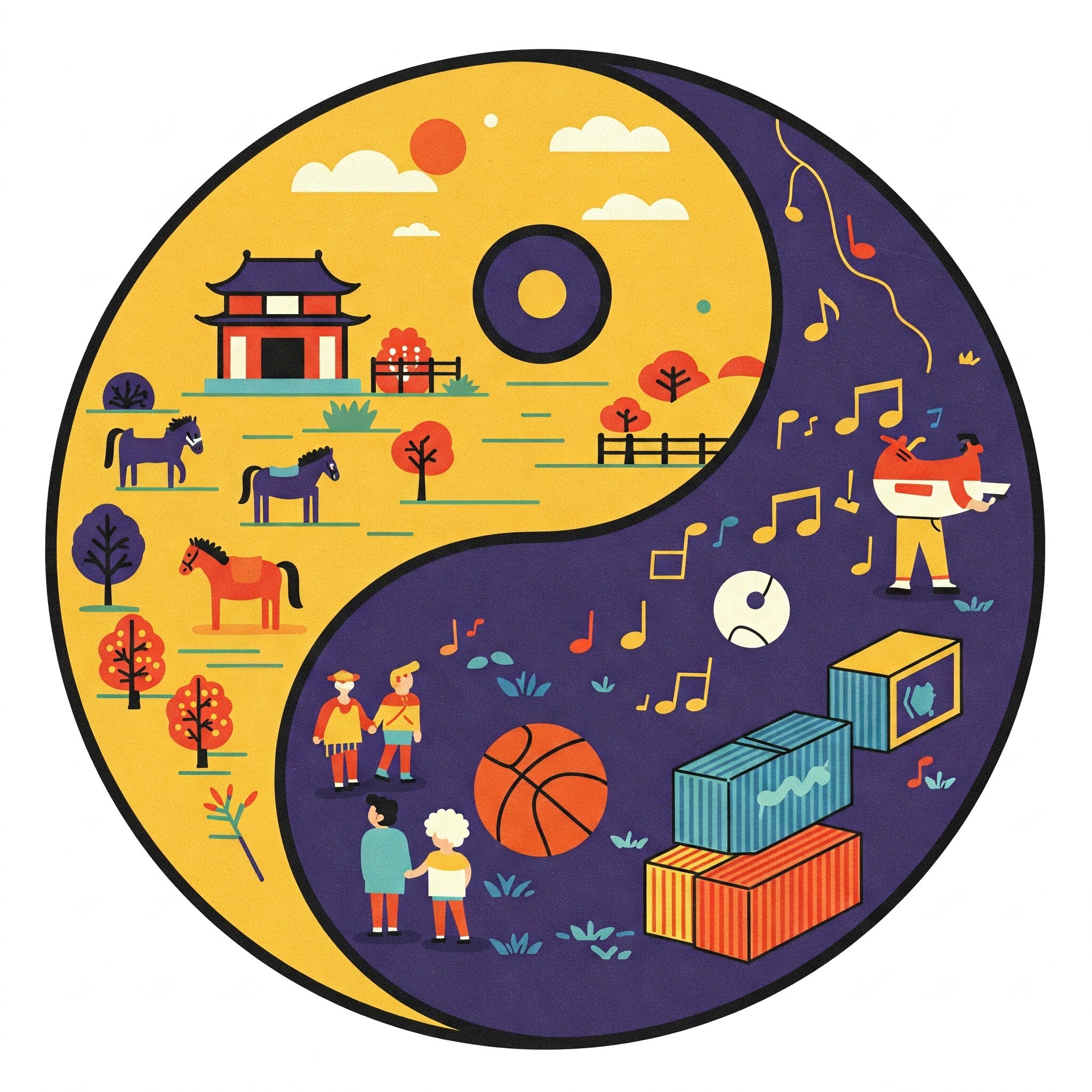
What appears at first glance as stoic detachment reveals itself, upon reflection, as profound systems thinking. The farmer intuitively grasps what modern complexity theorists labor to articulate: in sufficiently interconnected systems, categorical judgments become not just premature but fundamentally misaligned with reality. Good and bad aren't properties inherent to events but projections of our narrative-making apparatus onto an indifferent universe.
Yet we cannot help but impose structure. Our cognitive architecture demands it, like pareidolia compelling us to see faces in random patterns. The market reacting to this week's tariff announcements demonstrates this tension perfectly. The administration has taken a complex, self-organizing system and applied a simplistic intervention framework, then blamed that same complexity for failing to heal the disruptions it created.
What's fascinating about this dynamic isn't just its presence in geopolitics, but how it permeates domains far removed from international trade. Consider my fantasy basketball league, where I've become an unwitting practitioner of structured chaos. My team roster underwent a major metamorphosis this season—only 8 of my original 14 selections remain, casualties of the season's capricious injury gods. Yet this forced adaptation has yielded unexpected dividends.
Cade Cunningham, my fourth-round pick, emerged as my most valuable asset—an outcome no pre-draft algorithm could have predicted. Meanwhile, my third pick, Chet Holmgren, vanished into the injury void only to luckily return and save my season. The conventional wisdom would mark these developments as either fortunate or disastrous. The farmer would simply say: "Perhaps."
This pattern of structured mess—a term borrowed from urban theorist Vaughn Tan—provides a framework more nuanced than binary categorization. Tan observes that Tokyo's most vibrant neighborhoods aren't products of either rigid planning or complete disorder, but rather of "structured messiness": enough organization to function, enough chaos to evolve. My fantasy team, through injury-forced experimentation rather than design, stumbled into this sweet spot between order and entropy.
The NBA itself offers another example in the Luka trade and the Lakers' deployment of LeBron James. Mavs GM Nico Harrison may have applied the short-sighted heuristic of "defense wins championships," but in trading away their offensive hub for a defensive-minded center, the Mavs collapsed despite conventional wisdom suggesting their defense would improve. Meanwhile, the Lakers discovered something counterintuitive: by converting James into a roll target they unlocked more offense in the half court while still performing better defensively. The simplified offensive role created space for defensive engagement. When you reduce complexity in one domain, you sometimes enable it in another—a minor ray of hope for the tariff architects.
In this search for simplicity in complexity, I've also found myself developing an unexpected appreciation for the alapana, those improvised preludes in Carnatic music that I once dismissed as formless wanderings. As a child, I approached music with the same categorical simplicity that we instinctively apply to everything: structure good, chaos bad. Alapanas seemed like indulgent meanderings, lacking the clear melodic architecture I wanted. There was no clear beginning, no rhythm, no chorus. What I failed to recognize then was the exquisite complexity serving the simple goal of getting the listener to vibe.
Carnatic ragas aren't merely collections of notes but intricate systems defined by approach vectors to those notes, the specific distances between them, and the characteristic phrases that give each raga its distinctive emotional signature. An alapana isn't the absence of structure but rather a deliberate navigation of constraints—the musician exploring the multidimensional possibility space of a raga while never transgressing its boundaries. This is structure and chaos in perfect tension, creating something unique every time that could not exist through pure order or complete randomness alone.
The parallels to our broader social systems become evident when we consider that innovations rarely emerge from environments of perfect order. The complex interplay of constraints and freedoms—what Tan would recognize as structured messiness—creates the conditions for adaptation. Tokyo's architectural heterogeneity, with its fragmented ownership patterns preventing synchronized development and its fairly applied building codes preventing a tragedy of the commons, has produced neighborhoods that continuously rejuvenate without centralized planning. The lesson isn't that all structure is detrimental, but rather that the right kind of structure—one that accommodates and even encourages unpredictable variation—enables systems to evolve rather than stagnate.
Perhaps we can extract wisdom from these disparate domains that illuminates our approach to both personal and collective challenges. The Chinese farmer understood intuitively what many of us struggle to internalize: our judgments about events often reflect our limited perspective rather than any intrinsic quality of the events themselves. This doesn't suggest we abandon evaluation entirely. It suggests instead that we hold our assessments lightly, with the humility to recognize their provisional nature.
The tariff situation unfolding across global markets offers a case study in what happens when we fail to embrace this nuance. By imposing simplified solutions onto complex systems and categorizing outcomes through binary frameworks, policymakers risk undermining the very structures that facilitate adaptation. Complex systems require interventions that respect their complexity. They demand approaches that create guardrails without dictating precise outcomes.
What I find most compelling about structured messiness as a conceptual framework is how it acknowledges both our need for order and the benefits of variation. We cannot function in pure chaos, yet we cannot thrive under absolute rigidity. The basketball general manager who trades away offensive genius for defensive prowess based on oversimplified heuristics fails to recognize how these domains interconnect. The music listener who dismisses improvisational complexity misses the sublime interplay between structure and freedom. This balancing act between form and fluidity appears fundamental to resilient systems.
The lesson I take forward is that our most robust frameworks must accommodate unpredictability without surrendering to chaos. They must provide structure without mandating uniformity. And maybe most importantly, they must allow us to respond to events with the farmer's wisdom, recognizing that our categorizations often reflect our own limitations rather than fundamental reality.
Perhaps what we need, in domains ranging from trade policy to urban planning to personal decision-making, is not the elimination of judgment but its suspension—creating space for adaptation before rushing to conclusions. The most resilient systems, like the most resilient individuals, maintain enough structure to function while allowing enough variation to evolve.
Perhaps.
Prompt Ingredients
A Core Philosophical Principle: Something that challenges binary thinking (like the Chinese farmer's "Perhaps" parable)
A Current Event: Preferably something complex with multiple interpretations (tariffs, policy changes, cultural shifts)
A Personal Experience: An area where you've witnessed complexity firsthand (sports, hobbies, work)
A Specialized Domain: A field with intricate rules and constraints that somehow produces beauty or innovation (music, art, urban planning)
A Theoretical Framework: Existing thought that supports your analysis (like Vaughn Tan's "structured messiness")
Method
Begin with a philosophical anchor, introducing it through narrative rather than abstraction.
Establish the tension between our desire for simple categorization and reality's resistance to it.
Apply this tension to a current event, showing how simplified interventions often fail in complex systems.
Draw a parallel to your personal experience, highlighting an instance where adaptation within constraints led to unexpected positive outcomes.
Examine your specialized domain through this lens, revealing how structure and freedom interact to create something neither could produce alone.
Extract broader principles that apply across domains, emphasizing the universal need for balance between order and flexibility.
Conclude by suggesting how readers might apply this thinking to their own lives and decisions.
Where else can a reader find such breadth that sees the common threads between basketball, tariffs and Hindu scripture?